



Weighing may seem like a minor detail—until an error in the process starts to cost money. In a retail store, a slow checkout and inaccurate scale readings slow down the line and confuse inventory tracking, while in freight transportation, an underestimated axle weight results in a fine right on the road. Equipment for both tasks has long been available to Ukrainian businesses; all that’s left is to figure out what type of scale is right for you.
For retail, these are self-service scales—devices where the customer weighs the merchandise themselves and receives a label with the weight, price, and barcode. For transportation, warehouses, and the agricultural sector—under-chassis truck scales a>, mobile platforms that weigh a truck by axle directly on the company’s premises, without the need for a stationary weighing system.
Self-service scales: faster checkout and fewer errors
The customer approaches the terminal, places the item on the platform, selects the item on the screen, and picks up the printed label. At the checkout, the label is simply scanned. For the store, this means shorter lines during peak hours and a lighter workload for cashiers, who no longer have to spend time weighing each item.
The second benefit is inventory management. The label contains the exact weight, price, and barcode, so the human error associated with manual entry is virtually eliminated, and the data is immediately entered into the inventory system. For store formats with a high proportion of weight-based goods—such as produce, fruits, nuts, prepared foods, and the farm-to-table section—this significantly impacts both the checkout line’s throughput and the accuracy of inventory counts.


These scales work well in conjunction with the rest of the checkout equipment: integration with the POS system and accounting software incorporates weighing into a single sales process—from the shelf to the receipt.
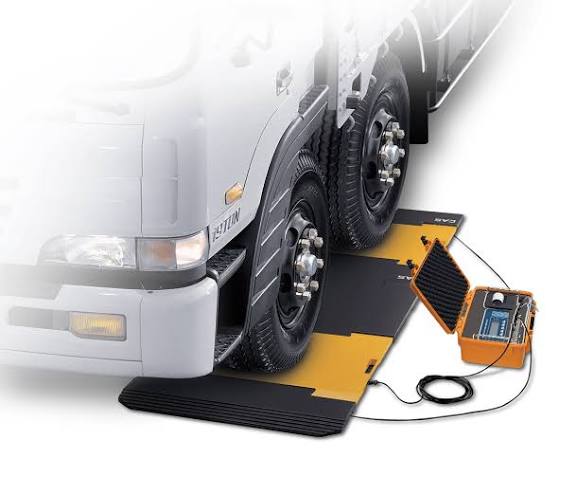

Portable scales are mobile platforms that are placed under the wheels to measure the load on each axle separately and, in total, the vehicle’s gross weight. They operate both while stationary and during slow entry, and wireless data transmission to the terminal eliminates the problem of damaged cables on-site.
Their main advantage is mobility. In places where installing a stationary weighing system is impractical or uneconomical (a field during harvest, a temporary warehouse, a recycling collection point, or a quarry), under-wheel scales provide an accurate reading in just a few minutes. The typical margin of error for such devices ranges from 0.5% to 5%, depending on the model and conditions, which is quite sufficient for real-time monitoring of loading and unloading operations.
How Much Does Overloading Cost—and Why the Scales Pay for Themselves
This is where the economics of fines come into play. Ukraine uses an automated weight-in-motion (WIM) system: WIM stations embedded in the road read the weight, axle loads, and license plate number while the vehicle is moving, after which a citation is issued without stopping the vehicle. According to OpenDataBot, automatic fines for overloading range from 8,500 to 51,000 UAH, and a citation is issued for each recorded violation—three checkpoints along the route mean three separate citations.
The amount of the fine depends on the percentage by which the applicable axle load limits are exceeded (approximately 11 metric tons per single axle). Indirect costs are added to the direct ones: a truck being detained until the violation is corrected disrupts delivery schedules and damages the relationship with the customer, while systematic overloading accelerates wear and tear on the suspension and brakes.
Against this backdrop, floor scales pay for themselves after just a few weigh-ins: the driver checks the weight distribution before departure and avoids fines that could easily have been prevented.
What to Look for When Choosing
The criteria differ for retail and for transportation, so you should choose based on your specific needs.
For self-service scales, the following are critical: barcode label printing, integration with your POS and accounting systems, a user-friendly interface for customers, and a maximum weight capacity sufficient for the application. Metrological calibration should also be taken into account—scales used in retail are subject to state metrological control.
For under-frame truck scales, other parameters are important: weighing type (static or dynamic), permissible axle load, accuracy class, battery life, and wireless connectivity, as well as the presence of a certificate if the data is required for official accounting or reporting.
What to Choose
Both types of scales share a common purpose: they eliminate human error and provide businesses with accurate figures where those figures directly translate into revenue. In a store, this means faster checkout and accurate tracking of weighed goods; in transportation, it means protection against fines and unnecessary wear and tear on equipment. A smart approach is to select equipment based on your specific workflow and actual volume: a small difference overlooked at the start often results in losses down the line.