


The material reflects the author’s personal experience and his interpretation of events. The facts are documented.
It’s a normal evening. My child wants to draw on the iPad. I open Drawing Desk, an app we’ve used before. A window pops up: ‘7 days free, then $4 per month.’ I think, ‘Ok, I’ll remind myself to cancel before the end of the trial.’ I press ‘Start trial.’
A minute later, a notification from Monobank: $48 (≈2000 UAH) has been debited. Not $0. Not $4. $48 for a year, right away.
It turns out that I had already used free access to this app on another iPad — maybe a year ago, maybe longer. The system knew this through my Apple ID. But instead of saying ‘trial unavailable’ or showing the real price, Drawing Desk showed the same ‘free access’ banner — and charged me for a year’s subscription without warning.
An odyssey began: Apple Support refused within 24 hours. The app’s founder acknowledged the problem on LinkedIn and promised to refund me via PayPal — then disappeared for two weeks. So I contacted Monobank to dispute the payment. Two months later, the money was returned.
This story is about how large companies acknowledge problems but don’t fix them, and how a Ukrainian bank proved to be more effective than international corporations.
Technical trap: when the system deliberately deceives
Let’s break down what actually happened. I have two iPads. On the first one, I once (a year ago? more?) tested Drawing Desk, a drawing app with a free trial. I don’t remember the details, it was a long time ago.
Apple ID is the key that links all your devices. The system remembers: this email has already used the trial in Drawing Desk. This is normal — you have to keep track somehow so that people don’t create endless accounts for free access.
But here’s what happened: when I opened the app on my second iPad, the system showed me the same banner: ‘7-day free access. Then £4/month’. No warning. No hint that it was no longer available.
I clicked ‘Start free trial’ — and I was charged £48 for an annual subscription. No warning. No confirmation. No option to cancel.
Technically, it could have been implemented differently: showing a message about the trial being unavailable or displaying the actual subscription price. But the current implementation creates a discrepancy between the user’s expectation (free) and the actual result (a $48 charge).
Attempt #1: contacting Apple Support
The first thing I did was go to reportaproblem.apple.com. I found the transaction and clicked ‘Report a Problem’.
I wrote in detail: the app showed a ‘free trial’, I clicked on it, expecting free access, but I was charged £48 for a year. I did not agree to pay £48. I added screenshots of the banner.
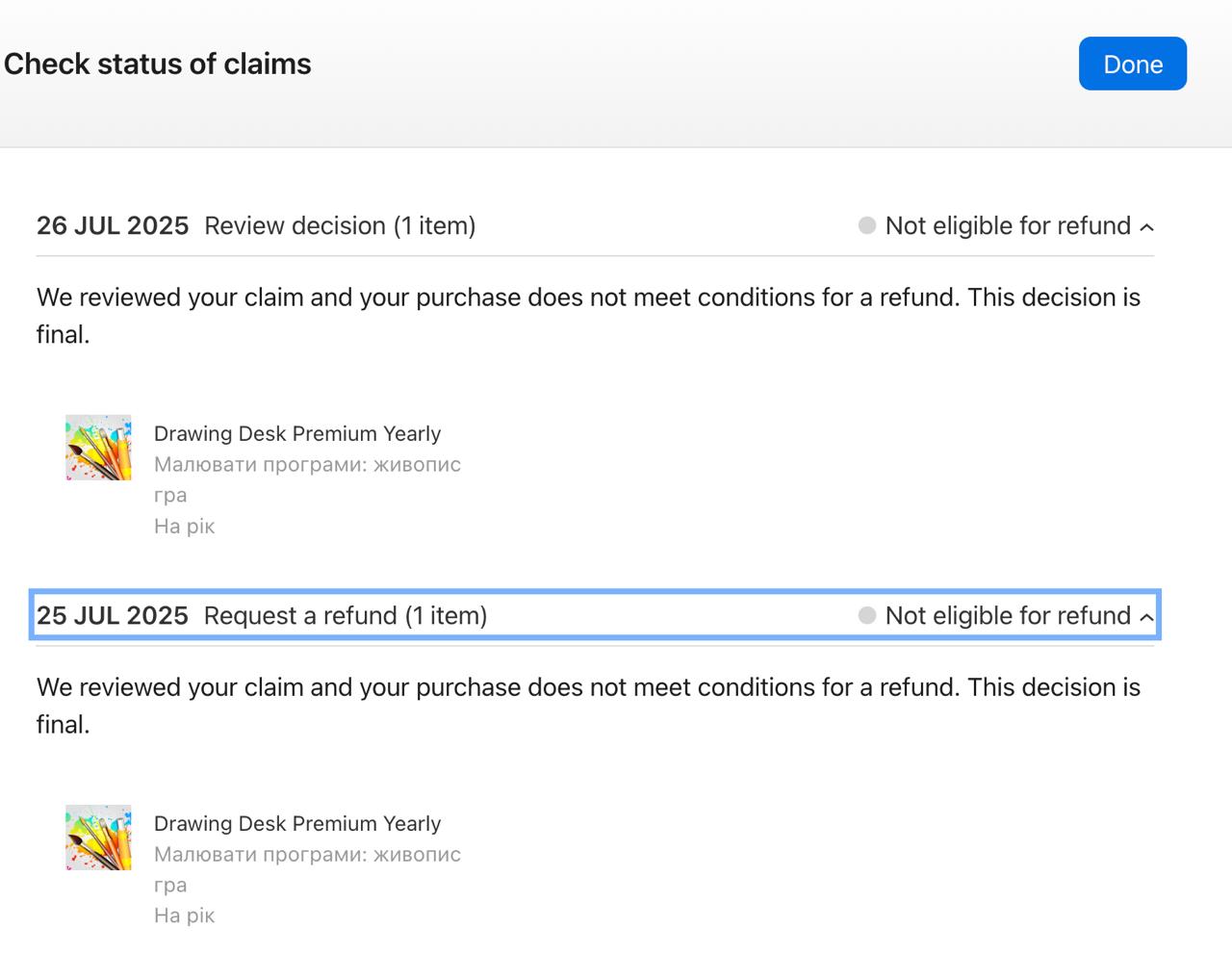

The response came in 24 hours. Standard template: ‘The purchase was made from your account and confirmed via biometrics, so it is considered valid. We cannot refund the money.’
No comment on the discrepancy between the banner and the actual charge. Simply: the transaction went through from your account = your problem. Case closed.
Attempt #2: I write to the founder on LinkedIn
Okay, I think if Apple isn’t helping, I’ll try writing directly to the app developers. Maybe they’ll be more reasonable?
I Google and find the founder’s LinkedIn. I write a message. No emotions, just the facts: your app showed me a ‘free trial’ even though I had already used it. The system knew this but decided not to tell me. The result — £48 debited without warning.
I wait a day. And suddenly — a reply! What’s more, he acknowledges the problem. Apple gave me a standard response, but here a person confirms that there really is a problem. He asks for my PayPal details and says he will refund the money. I send them. That’s it, I think, the issue is resolved.
A week goes by. Silence.
A second week. Nothing.
I write again — ignored.
Once more — he doesn’t even read it.
Result: the promise to refund the money was not fulfilled. Why — I don’t know. Maybe technical difficulties, maybe other reasons. But the fact remains: after two weeks of waiting, there was no money.
Attempt #3: I go to the bank to dispute the payment (dispute in Monobank)
After two weeks of waiting for the promised money from the founder, I decide to use the last tool — disputing the payment through the bank.
The logic is simple: I was shown a ‘free trial’, I clicked on it, expecting free access. But they charged me $48. The banner created the wrong impression about the cost. If the trial is not available, the system should communicate this.
I write to the Monobank Telegram bot. I explain the situation to the operator. And then magic happens.
Instead of sending me a link to some form, the operator starts asking the right questions:
- What exactly did the app show?
- How much did you expect to pay?
- What was actually debited?
- Did you try to resolve this with the seller?
- What evidence do you have?
I answer each question and send screenshots:
- Correspondence with Apple Support (refusal)
- Correspondence on LinkedIn with the founder (acknowledgement of the problem + PayPal promise + no response for two weeks)
- Banner with ‘free trial’
- Transaction for $48
The operator says: ‘Okay, I’ll fill out the application based on your answers. You’ll just need to confirm it in the app.’
After 20 minutes of chatting on Telegram, I open the Monobank app — there’s a transaction with the status “Disputed”. I click ‘Confirm’. That’s it.
The bank warns me about the conditions:
- If I lose, they will charge me $19 (≈800 UAH) for reviewing the case
- If I win, I will get all $48 back
- The review may take up to 60 days
I agree. $19 risk versus $48 potential return — fair odds. Especially when I have a lot of evidence of the discrepancy between what was shown and what actually happened.
A month later, a notification arrives: ‘The dispute has been resolved. $48 has been refunded to your account.’
The payment system reviewed the case, looked at the evidence — and sided with me. The money was returned.
Why does this practice exist? The economics of subscriptions
When I figured out the whole situation, the question arose: why does this system remain unchanged?
The answer probably lies in the economics of digital subscriptions. When the interface gives the impression of free access but leads to a paid subscription, it affects conversion rates.
From a business model perspective:
- Drawing Desk generates revenue from subscriptions
- Apple receives 30% of each transaction in the App Store
- The current implementation does not technically violate the platform’s rules
At the same time, Apple, as the platform owner, could set stricter requirements for displaying prices and trial availability. But there are no such rules at the moment.
The founder of Drawing Desk acknowledged the problem in response to my appeal. But the system remains unchanged. I don’t know the reasons for this — perhaps technical difficulties, perhaps other priorities in development.
If you decide to appeal: what you need to know
I was lucky — I won the dispute and got my money back. But that doesn’t mean it will always be that way.
The bank may reject your application if:
- This is not the first time. If you have a history of regular ‘accidental’ purchases that you are disputing, the bank will see a pattern and refuse.
- Too much time has passed. More than 120 days — the chances are almost zero.
- There is no evidence. If you cannot show that you tried to resolve the issue with the seller, your case is weak.
Most importantly: keep everything. Correspondence, screenshots of refusals, dates of appeals. This is your evidence base.
And now about the biggest risk — blocking your Apple ID.
Apple really dislikes disputes. From their point of view, if the bank has refunded the money, you are now a debtor. And they can:
- Restrict access to your account until you ‘pay off the debt’
- Block purchases in the App Store
- Close access to subscriptions and iCloud
In my case, nothing like that happened. Perhaps because:
- It was my first complaint (not a pattern of behaviour)
- The amount was small ($48, not $500)
- I had detailed documentation of the situation
But the risk is real. Especially if you have a lot of purchases, subscriptions, and photos in iCloud in the Apple ecosystem.
When disputing makes sense:
- You have exhausted all official channels (Support, contacting the developer)
- You have evidence of attempts at dialogue and refusals received
- The risk/benefit ratio is logical (do not dispute £5 with the risk of account suspension)
- This is your first dispute, not a habit
- You are prepared for the possibility of losing access to your Apple ID (or you don’t have any critical data there)
In my case, $48 was worth the risk. But this is a decision everyone has to make for themselves.
What I learned
This story began with a simple desire to use a drawing app. It ended with an understanding of how opaque monetisation practices work in the App Store.
The Ukrainian bank proved to be an effective protection tool. Monobank didn’t just provide a complaint form — their support team helped me formulate my arguments, gather evidence, and build a case. Through a Telegram bot, in 20 minutes, free of charge. This is a working consumer protection mechanism.
Payment disputes work. But this is a tool of last resort, not the first line of defence. There are risks (account blocking), there are costs ($19 if you lose), there are delays (up to 60 days). But if there is documentary evidence of the problem, there is a chance of a positive outcome.
Most importantly, this is not about user inattention. It’s about a situation where the interface creates one impression (free access) and the result is another ($48 charge). And until the platform establishes clearer rules for displaying prices, such cases will continue.
But now I know: when standard channels don’t work, a Ukrainian bank can be an effective tool for solving the problem.