


There is a context that rarely comes up in discussions of “success.” Ukraine is living through a protracted war—marked by chronic stress, loss, uncertainty, and shifting priorities. In this reality, “productivity” begins with basic survival, not with achievements. This is well-documented: surveys on the mental state of Ukrainians during the war show high rates of people experiencing psychological difficulties—and strikingly low rates of those who seek professional help.
Meanwhile, the feed carries on as usual. “Business with a Soul” shares only warm reviews and heartwarming stories. Threads is overflowing with hype and provocations—and at the same time, with people who have just “rethought everything” and are sharing their wisdom in three paragraphs. And alongside that—the usual set:
- “business in three months”
- “passive income”
- “morning routine”
- “I finally figured out how to live”
- “I moved to the countryside and renovated an old cottage”
- “I renovated a new apartment in three days”
- “I doubled my crypto account in an hour”
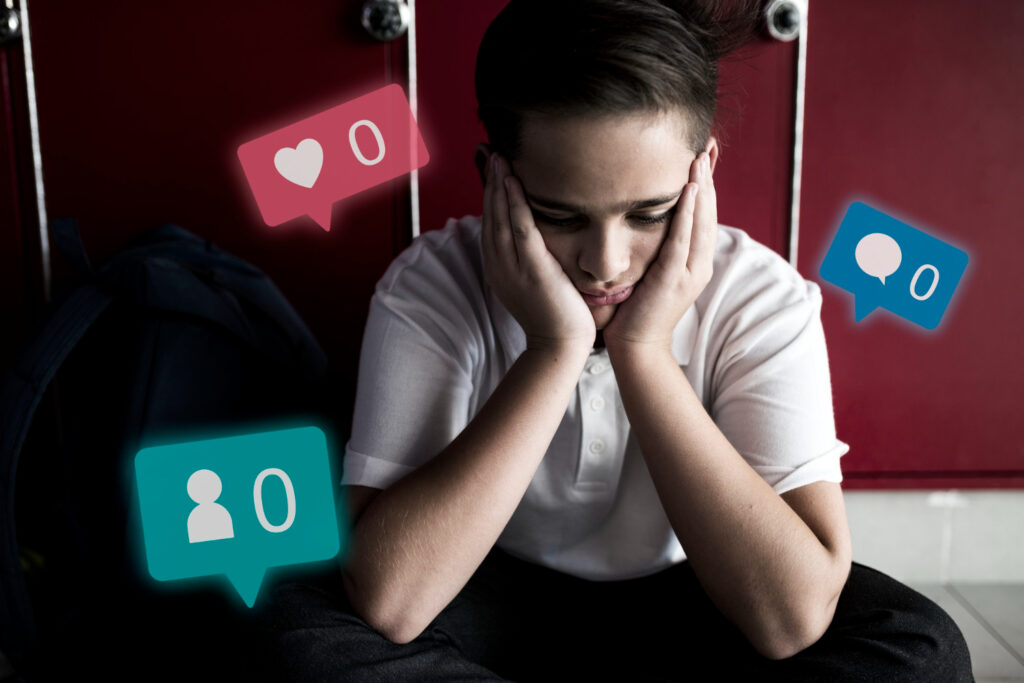
People look at this—and feel it. Envy. Frustration at the disconnect between the image and their own reality. The feeling that others have already figured out how to live. And it’s no longer just a feeling. According to data from the World Happiness Report 2026, heavy social media use is linked to lower life satisfaction, and for teenagers, the effect is so significant that it impacts population-level metrics
Part of this effect has a neurobiological explanation. Scrolling through the feed triggers dopamine micro-releases—short, frequent, and predictable. The brain receives a signal of pleasure simply from the movement of a finger, even before it has time to process what it sees. The reaction occurs before critical thinking. But in this mode, critical thinking takes a back seat: the image is perceived directly, without a filter. Yet the effect isn’t limited to the brain’s individual reaction. Data from Europe shows that increased social media use is linked to a decline in trust, the number of social contacts, and a sense of belonging—factors that directly influence happiness levels


The gap between what a person actually experiences and what is sold to them as the norm takes on a particularly toxic nature in Ukraine. The starting conditions here are radically different—and this fact is almost never taken into account by the motivational industry.

Another dimension is the market’s scale. According to estimates by IAB Ukraine and Inweb, the volume of influencer marketing in 2024 reached 714 million UAH, with a sharp increase compared to the previous year. Influencer marketing in Ukraine has long since moved beyond the realm of a niche genre. “Successful success” is part of the commercial infrastructure: motivational narratives, courses, marathons, affiliate integrations, and targeting all feed into a single funnel.
This is where the controversial concept of “parasitism” arises. In a country with high levels of anxiety, the promise of an “easy way out” or a “quick breakthrough” has a higher conversion rate—because it sells relief. This is not just a metaphor. Studies describe the “product trap” effect: people use social media not because it makes them happier, but because everyone else is there. Moreover, after quitting these platforms, their well-being improves, yet they are still not ready to give them up entirely.
A separate issue is advertising transparency. The market attempts to self-regulate through codes of ethics and guidelines for influencers, though this does not eliminate the incentives to conceal commercial interests. At the same time, there is an ongoing debate about updating advertising regulations—and about how “sophisticated” forms of advertising circumvent existing rules.
When a country is at war, the price of such content is different. In conditions of chronic stress and exhaustion, a feed that systematically reinforces the feeling of “I’m falling behind” acts as additional pressure. The very same commercial model that sells “a dream” in calmer times often sells “guilt” during war.
This is precisely where the questions arise:
- how the feeling of “I’m not enough” has become the most stable asset of the digital economy,
- why the feed never gives you the feeling that you’ve already done enough—and who benefits from this,
- about the price—the one not listed in the course description and not included in the subscription bill, but which stays with you after you close your phone.
Why do I want to bring this up?
I joined social media to see my friends. Over time, the algorithms changed the rules. Instead of the people you came for—an endless stream of strangers’ achievements and strangers’ stories. Everyone is fighting for your attention, openly or covertly.
The feed comes on its own—every morning, while waiting in line, before bed. You close your phone, but the feeling remains. As if your pace is wrong. As if you’re falling behind.
It’s envy, admiration, and something heavier all at once. From this heaviness, another feeling emerges: that they’re parasitizing off you. Off your attention. On your hope. On your “just a little more—and I’ll be there too.”
I work on research about the impact of social media on psychological well-being—and it is precisely this dual position, as both user and researcher, that prevents me from perceiving the experience described as a personal weakness. What is felt in the feed is also reflected in the data.
I’m interested in how this works. The question is how the feed is structured and how it makes money.
When you start to look at this from the outside—through research, through personal experience—several layers become visible, overlapping one another. Algorithms, the economics of social media, the mind’s reaction. Together, they create an effect that’s hard to explain in a single word. It makes sense to start with what’s already been well-documented.

What research says about “successful success”
Social media as a normative environment
According to data from the U.S. Surgeon General’s Advisory on Social Media and Youth Mental Health (2023), up to 95% of teens aged 13–17 use social media, and over a third do so almost constantly. For many, the feed is an everyday environment where perceptions of the norm, success, and the “right way to live” are formed—not just entertainment or an information channel. The feed doesn’t reflect reality—it defines it.
We are gradually getting used to a new yardstick for measuring ourselves—often without even noticing when exactly this happened.
Social comparison and a shifted reference point
One of the most consistent findings in social media research is the role of social comparison. People tend to compare their daily lives with others’ achievements, presented in the best possible light.
A meta-analysis of studies on social comparison in the media, published in Human Communication Research (2023), shows that simply scrolling through a feed has nearly the same psychological effect as intentionally consuming “ideal” content. The reason is simple—the feed is already pre-selected by algorithms.
In such a situation, the reference point shifts. What recently seemed like a sufficient result begins to look like falling behind—the feed has replaced the norm. Researchers increasingly describe social media as socio-technical environments in which algorithmic content curation directly influences the psychological perception of reality.
Passive scrolling as a source of stress
Passive consumption often has the greatest impact—no comments, no interaction, just scrolling. Recent review studies confirm that social media has a broad and multidimensional impact on mental health, encompassing anxiety, depression, and the influence of visual content on self-perception.
It is precisely this mode of engagement that is associated with higher levels of anxiety and reduced well-being. A person may not plan to buy anything or compete with anyone—the body reacts predictably: with fatigue and a feeling of “I’m not enough.” Passive content consumption is associated with a decline in psychological well-being and emotional exhaustion even without active interaction.
This background noise doesn’t turn off.
Why the feed is skewed
People began comparing themselves to others long before social media—and there used to be limits to this. You could choose not to attend a gathering and avoid the comparison. The feed comes to you on its own—every morning, while waiting in line, before bed. The selection within it is uneven from the start.
Research on algorithmic systems shows that emotionally charged content is prioritized because it holds attention longer and elicits more reactions—particularly vivid success stories.
As a result, people regularly compare their ordinary day with someone else’s most successful moment.
Algorithms and the Economy of Attention
Social media began as a space for communication. Over time, user attention became an economic commodity: the longer a person stays in the feed, the higher their value for the advertising model.
An audit of the algorithms of Platform X (Twitter), conducted by researchers at UC Berkeley, showed that engagement-based ranking systems systematically amplify emotionally charged content compared to a chronological feed. Users did not consciously choose this bias—the choice was made for them.
A format that looks authentic
In this system, influencers tend to adapt to existing rules. Research in the field of influencer marketing shows that a format that looks authentic and personal increases trust, and trust is directly linked to reach and the effectiveness of commercial integrations.
That is precisely why stories about the journey from “rock bottom” to success are repeated over and over—this format fits organically into the algorithmic and economic logic of the feed.
How it all fits together
Each of the described elements individually looks like a technical detail. The algorithm amplifies emotional content—that’s business logic. People compare themselves to others—that’s psychology. Marketing leverages trust—that’s communication. Together, they form a closed loop: algorithms amplify content that triggers an emotional response; engagement turns attention into a commodity; the psyche reacts to constant comparison as a signal that “I am not enough”; the industry of courses and marathons capitalizes on this state and sells temporary relief—until the next cycle.
How exactly your attention is converted (schematically):
— The algorithm amplifies emotional content
— Content triggers tension
— Tension increases engagement
— Engagement is monetized
— The industry sells relief
— Relief is short-lived
— Tension returns
No single study formulates this as “tension → product” in a single line. Research papers clearly describe each link separately. Together, they form a system where the user’s internal tension becomes a resource.
“Parasitism”: Between Marketing and Manipulation
The word “parasitism” sounds harsh in the context of social media—and that is precisely why it deserves separate consideration. Researchers in digital ethics are increasingly asking: Do corporations have the right to manipulate human attention without meaningful, informed consent? Legally, this question remains open—ethically, its consequences are clear.
Marketing works with desires. Manipulation works with states that a person did not choose. The difference is subtle but palpable: one offers a solution, the other first creates or amplifies a problem—and then offers a solution.
In the case of the news feed, the mechanism works like this: the algorithm amplifies content that triggers anxiety or a sense of inadequacy. The industry of courses and marathons emerges precisely at this point—with the promise of relief. People pay to escape a state that was partly shaped by the very environment where they are sold this escape.
This doesn’t mean that every influencer or every course acts with the intent to manipulate. Intentions here are largely irrelevant—the system works this way regardless of them. This is precisely what makes “parasitism” an apt term: it describes a structure, not personal guilt.
An ethical problem arises when this structure becomes hidden. When advertising looks like sincere advice. When commercial interest is disguised as concern. When a person, in a moment of anxiety, receives a “solution” and fails to see that the anxiety itself was part of the funnel.


What happens to a person
The influence of social media builds up gradually. No single post destroys self-esteem; no single success story on its own leads to exhaustion. The problem lies in repetition.
Reviews of the literature show that the impact of social media on mental health encompasses complex changes—in self-perception, fatigue levels, life satisfaction, and a sense of control.
When social comparison becomes a daily backdrop, the internal scale shifts. A person begins to evaluate themselves, their pace, and their achievements differently. What used to be normal now seems insufficient. What was once difficult starts to look like “I’m just not trying hard enough.”
Research shows that passive content consumption is linked to an increase in anxiety and depressive symptoms more strongly than active engagement. Scrolling creates the effect of a constant presence of someone else’s results alongside one’s own routine—and this presence is not neutral.
This gives rise to familiar states: a chronic feeling that you’re falling behind, guilt over taking a break, a life on hold—“I’ll start when I catch up”—and impulsive decisions to buy something just to finally stop lagging behind.
In the context of the war in Ukraine, this compounds existing exhaustion. People expend energy on safety, on adaptation, on keeping their families and jobs afloat amid instability—and simultaneously receive signals that they could do even more, faster, on a larger scale.
Social media is not the only cause of psychological difficulties. It acts as an amplifier, normalizing a pace that most people physically cannot sustain.
As a result, a strange dichotomy emerges: on the outside, life seems to be moving forward, while fatigue builds up inside. This fatigue is rarely directly linked to the news feed—it feels like a personal weakness.
This is precisely where it’s important to pause—to notice the mechanism itself.
Report 2026: When Data Confirmed What We Already Felt
This March saw the release of the World Happiness Report 2026—an annual study by the Oxford Centre for Wellbeing in partnership with Gallup and the UN, covering over 140 countries. This time, its central theme is social media and happiness. And the data proved inconvenient for those accustomed to speaking of platforms as a neutral tool.
The first conclusion concerns not the content, but the format. The most problematic turned out to be platforms where the primary mode of use is passive, and the content is predominantly visual and comes from influencers—precisely because it encourages social comparison. Not social media in general, but a specific form of it: an algorithmic feed of others’ achievements that you scroll through silently, without posting anything in response.
The second conclusion concerns scale. Researchers argue that the harm and risks to individual users are so diverse and widespread that this justifies the conclusion: social media causes harm at the population level. This is no longer about individual susceptibility.
The third conclusion concerns the retention paradox. The report describes the so-called “product trap”: people who deactivated Facebook for a month became happier, less anxious, and less prone to depression—but after this experience, they still demanded a significant sum of money to stay off the platform for another month. The improvement effect was documented. But the relapse still happened. This is no longer a matter of personal discipline—it’s a matter of design.
And finally—the difference between platforms. Platforms designed to support social connections have a clear positive correlation with happiness levels. In contrast, platforms with algorithmic content show a negative correlation with heavy use. WhatsApp, where you message a friend, and Instagram, where you scroll through others’ feeds, are different environments with different consequences. They’re just called the same thing: “social media.”
For Ukraine, this conclusion takes on a special dimension. In a country where anxiety levels are already elevated not because of algorithms but because of reality—an environment that systematically reinforces the feeling of “I’m falling behind”—it acts as additional pressure on top of what already exists. The report notes this indirectly: the authors point out that the internet can exacerbate existing social problems rather than being their sole root cause—specifically through a decline in trust, a reduction in offline interactions, and the feeling that one is falling behind socially. In a war context, these factors are already present—the feed merely amplifies what is already there.
Why the system isn’t interested in your peace of mind
After all that has been said, a natural desire arises to find a simple solution: spend less time on your phone, unfollow motivational accounts, stop comparing yourself to others.
These are understandable impulses. They just don’t address the core issue.
We live in an environment that systematically offers an external scale for self-assessment. This scale is designed to hold our attention and sell solutions. Courses and marathons will sell temporary relief to people who are already exhausted—particularly in Ukraine, where exhaustion stems from a completely different source.
It’s impossible to change this environment alone. But you can stop accepting it as the norm.
Research shows that even without drastically cutting back on time spent on social media, a mindful approach to content mitigates the negative effects of social comparison and anxiety—through an understanding of exactly how the feed works and what it does to a person.
The moment a person realizes that inspiration is turning into pressure is already a change. A real one, though not a dramatic one. At that moment, responsibility returns to where it belongs—to the system that shapes these feelings.
In the scientific literature, it is increasingly emphasized: the quality of interaction with content matters. How a person reads the feed—as background noise, as a guide, or as a curated product—is linked to their level of anxiety and emotional well-being.
This doesn’t require public gestures. You don’t have to delete anything, declare a “detox,” or prove your awareness to anyone. Sometimes it is enough to internally disagree with the imposed scale.
The ability to notice what exactly draws you in on the feed, what causes tension, and why the algorithm keeps showing exactly that—is linked to reducing negative effects and regaining a sense of control. This is a conscious change in consumption style, not just another detox.
Systemic problems aren’t solved by individual awareness. They change when enough people stop accepting the rules of the game—and this starts to put pressure on advertisers, platforms, and regulators. That is precisely why advertising transparency, algorithmic accountability, and regulatory discussions are the points where individual dissatisfaction can turn into something more.
Perhaps the most important question here isn’t even about the feed, but about when and why we agreed to consider this pace, these results, and these stories the universal norm. And is this really the standard against which we want to measure our lives—especially in a reality where so much energy is spent simply on keeping up?
Mykola Kovalenko — I research the potential of social media Big Data in public health monitoring.