


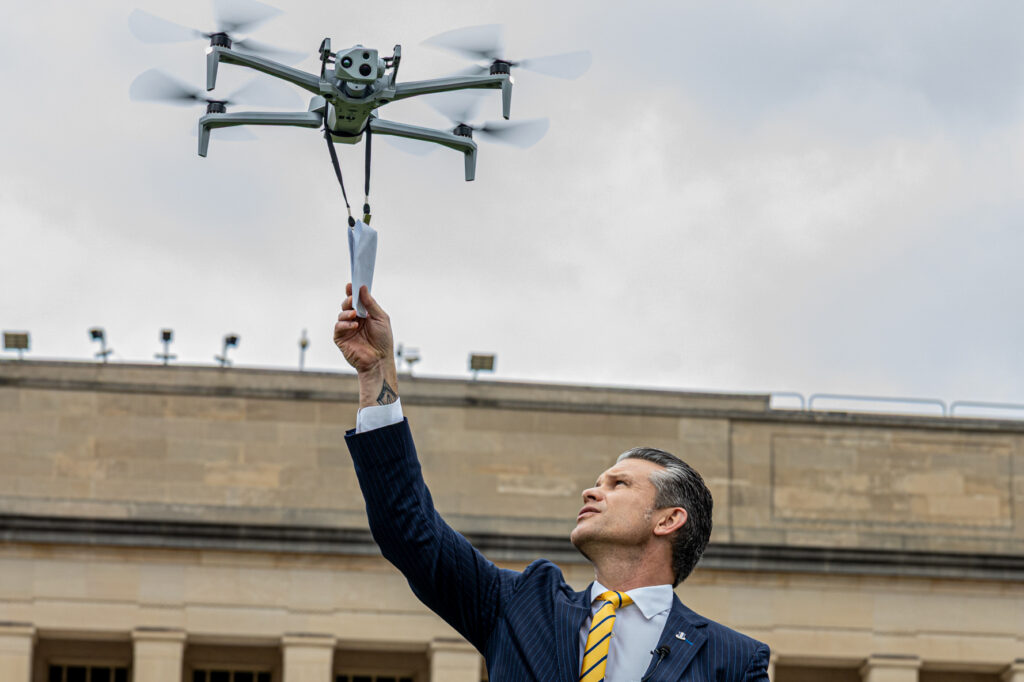
The Pentagonwants to purchase Ukrainian interceptor drones for $1,000 each. An interceptor missile costs between $100,000 and $3.9 million. That’s a difference of 100 to 3,900 times. This is the essence of what’s happening with defense unit economics in 2026—and this is where business opportunities open up for those who seize the right niche at the right time.
Why an FPV drone without AI is just a useless piece of plastic
To understand why AI is changing everything, you first need to understand the problem. A combat drone lives or dies depending on whether it has a connection to the operator. And often, there is no connection.
A drone or ground robot without autonomous navigation cannot reach a designated point on its own. This is critical because a Russian electronic warfare station jams the signal—and a $500 FPV drone becomes a useless piece of plastic at the most critical moment of the operation.
Against the backdrop of the current fiber-optic supply crisis, more and more manufacturers and units are switching to autonomous solutions. They are cheaper, operate over greater distances, and are significantly less dependent on scarce components. This is no longer a fallback option—it is one of the key directions of development on the modern battlefield.


AI is neither hype nor a competitive advantage. In the specific combat conditions of 2026, it is a prerequisite for a product’s survival in the market.
What AI adds to a drone: two modules
Brave1 has placed artificial intelligence at the center of its 2026 strategy: the company is developing modules for autonomous target identification, optical navigation, and precision guidance systems. Two key modules that change the cost of the operation:
Autonomous navigation. The drone maintains its course and reaches the target even with a complete loss of communication. Solves the problem of electronic warfare without changing the hardware platform—simply an additional software module on top of the existing hardware.
Target recognition and acquisition. The TFL-1 autonomous guidance system from “Fourth Law” allows the drone to automatically acquire and track a target. Together with “Ukrainian Armored Vehicles,” they integrated this system into the 8-inch UB60D FPV drone—strike effectiveness increased by 2–4 times.
That same $500 hardware platform with an AI module becomes 2–4 times more effective. The unit cost per target destruction drops proportionally. This is where the old logic of defense procurement breaks down.
How market arithmetic is changing
The global market for autonomous military systems is estimated at $19.8 billion in 2026, with growth of 10.3% per year. But what’s more interesting isn’t the overall figure, but the dynamics of specific companies’ valuations. Anduril is targeting $60 billion—a doubling in 9 months.
The Pentagon, as part of the Drone Dominance Program—a $1 billion plan over two years—has selected 11 supplier companies. One of them is the Ukrainian firm UDD. By 2027, the program plans to procure over 200,000 drones. These are not pilot projects.
Meanwhile, Auterion Airlogix—a joint venture between Airlogix and the American company Auterion—has received government funding from Berlin for the mass production of thousands of AI drones annually. The German government is providing the funding, with Ukrainian technology at its core. This has become a standard operating model.
Where business niches are opening up
Defense tech is not just about “building a drone.” The supply chain is much broader, and most of its niches remain unfilled.
- AI modules as a standalone product. The “Fourth Law” case study shows: there’s no need to build a drone from scratch. It’s enough to develop a guidance software module that can be installed on existing platforms. The barrier to entry is a team of ML developers, not a production line.
- Datasets and model training. Brave1, together with Palantir, launched Dataroom—a secure environment for training AI models on real combat visual and thermal datasets. Companies that collect and annotate such data are critical in the supply chain.
- Component manufacturing for mass production. A key lesson from manufacturers: don’t build complex, one-off systems; build systems that can be scaled. Engineering ideas only make sense when they become mass-produced. This opens up a niche for small manufacturing firms—housings, antennas, batteries.
- Testing and certification. Over 200 companies are involved in the production of AI-powered drones in Ukraine. With so many players, services for testing, verification, and obtaining NSN codes for new systems are becoming a separate, stable business.
Regulatory risk that should not be ignored
The UN wants a legally binding treaty banning fully autonomous weapons with a deadline of 2026. But the line between “autonomous” and “semi-autonomous” is technically blurred. Is an FPV drone that maintains target lock after losing communication with the operator an autonomous weapon? Computer vision algorithms that identify targets are based on the same models as Tesla’s autopilots.
For businesses, this means: jurisdiction and company structure matter from the start. Part of the scaling is already happening through British, German, and American legal entities with Ukrainian R&D inside—to resolve certification issues for the end buyer. A legal business structure abroad, with production and R&D in Ukraine—for some defense tech companies, this is already a standard operating model, not an exception.
Defense tech as an asset class: three signals from a single quarter
Three news items from Q1 2026 share a common thread: autonomy is becoming not just a technological trend, but a business model with measurable metrics.
- Swarmer went public on Nasdaq under the ticker SWMR—the first IPO in Ukrainian defense tech. Shares soared 950% over the first three trading sessions.
- Brave1 and Palantir launched Dataroom to train combat AI models—effectively the world’s first open market for combat datasets.
- The K-2 “Brigade” has deployed the world’s first battalion of unmanned ground robots—confirming that autonomy has moved from the lab to the battlefield.
For an entrepreneur or investor considering entering the sector, the key signal is simple: the market is shifting from “drones as hardware platforms” to “autonomy as a software product.” That is where the margin is generated, and that is where the barrier to entry is lowest for new players.
Read more
The broader picture of defense tech as a business sector—niches, supply chain, regulatory context: Defense tech as a business: what’s opening up for Ukrainian entrepreneurs right now.
About Swarmer, UForce, and other investment cases in Q1 2026: Ukrainian Startups 2026: Two Unicorns, the First IPO, and Defense as a New Growth Area.
Where defense tech fits into the global investment landscape of 2026: Investment Trends in 2026.