

Please, share ❤️
Three forces are shaping the investment landscape of 2026: artificial intelligence, which is changing the economy faster than previous technological revolutions; the biotech boom in obesity and cancer treatment; and the energy transition, which has received more money than the oil and gas sector for the first time.
Key points:
- AI infrastructure: $3 trillion in capital expenditure, less than 20% deployed (Morgan Stanley)
- Biotech M&A: big pharma is losing $128 billion in revenue due to patent cliffs by 2029, buying startups
- Clean energy received twice as much money ($2.2 trillion) as fossil fuels ($1.1 trillion) for the first time
- Emerging markets: +30% growth in 2025, valuations 30-50% below developed markets
- DEX turnover: $568 billion in October 2025, platforms simplify access without technical barriers
- S&P 500 forecast: 7,800 points (+14%) in 12 months
- Bitcoin ETFs brought in $30+ billion in new capital in a year
- Renewables: 36% of global electricity generation vs 32% coal
Here’s an overview of where the money is going.


Artificial intelligence: money follows electricity
Morgan Stanley estimates capital expenditure on AI infrastructure at $3 trillion, but less than 20% has been deployed. This is not just hype — companies are actually building data centres and buying chips.
The most interesting thing right now is not the AI companies themselves, but their suppliers. Bloom Energy found in its report on data centres that access to electricity has become the main factor in choosing a location, ahead of even internet connectivity.
In practical terms, this means competition for network capacity. Regions with cheap and reliable electricity will receive AI investments. Everything else is secondary.
Where to look:
- Chip manufacturers (obvious, but it works)
- Companies building energy infrastructure for data centres
- Power grid operators in regions with surplus clean energy
Is this a bubble? BlackRock, in its forecast for 2026, says that AI could push the US economy beyond the 2% growth trend for the first time in history. But this is ‘conceivable’ — possible, not guaranteed.
CeDeFi: how OKX simplified DEX trading
Decentralised exchanges turned over $568 billion in October 2025. The problem is that they are difficult to use. You need to remember seed phrases (12-24 words to access your wallet), pay gas fees in native blockchain tokens, and understand cross-chain bridges for transfers between different networks.
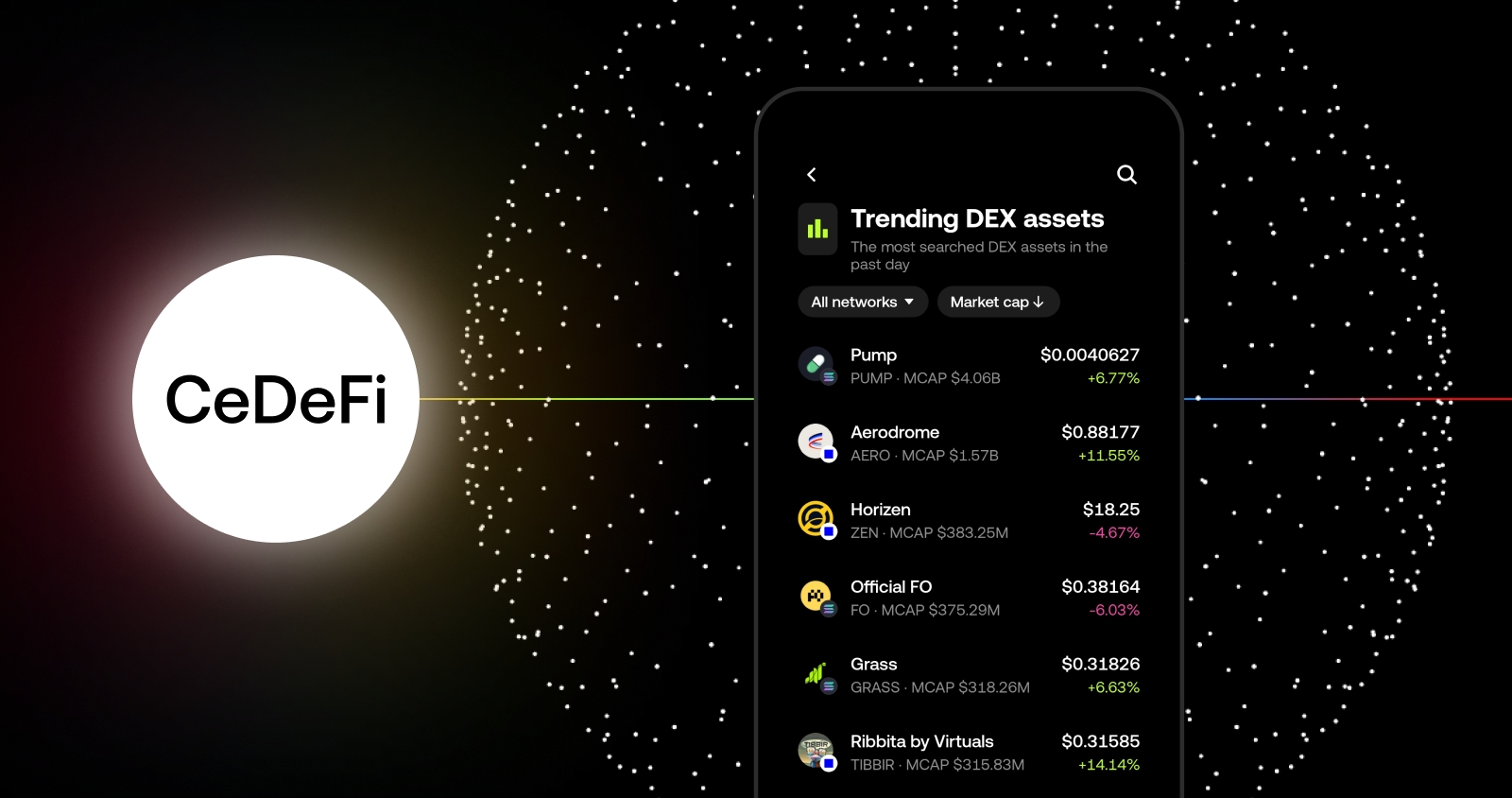
OKX launched CeDeFi on 14 November 2025 — a hybrid of a traditional exchange and a decentralised one. Simply put: the convenience of a banking app + control over your own funds.
How it works:
You create a non-custodial wallet (only you have access to the funds) directly in the OKX app, but you don’t need to store a seed phrase — the platform uses MPC (Multi-Party Computation) technology, which splits the keys into parts.
You pay fees in USDT or USDC instead of buying SOL, ETH or other tokens separately to pay for transactions. You confirm transactions via Face ID or fingerprint — just like in a banking app.
What you get:
Funds under your control (OKX cannot freeze them), but the interface is simple — just like a regular exchange. Access to tokens on the Solana, Base, and X Layer blockchains before they appear on centralised exchanges.
OKX publishes Proof-of-Reserves — an independent audit that confirms that the exchange’s reserves cover 100% of user deposits.
Who it’s for: if you want access to cryptocurrencies without learning the technical details of Web3. Minimum entry — from $50.
Biopharmaceuticals: M&A instead of IPO
The SPDR S&P Biotech ETF has risen 85% from its April 2025 lows to $123.43. But this is not an IPO boom — it is a wave of acquisitions.
Morningstar has calculated that large pharmaceutical companies will lose $128 billion in revenue due to patent expirations by 2029.
In 2028, they will be hit with $80 billion. They are buying biotech startups to fill the gaps in their pipelines. Johnson & Johnson paid $14.1 billion for Intra-Cellular Therapies. Pfizer paid $10 billion for Metsera after competing with Novo Nordisk.
These are not random deals — companies are fighting for assets in obesity and oncology.
The GLP-1 drug market (Wegovy, Ozempic) exceeded $50 billion in 2024. Analysts expect a peak of $200 billion before Wegovy’s patent expires in 2031.
AI in drug development is no longer an experiment. Eli Lilly is building an AI supercomputer with NVIDIA for trillions of molecular simulations annually. 78% of pharma executives in a Deloitte survey say AI will play a central role.
Where to look: biotech is trading at a 15% discount to the broader market. Large pharma companies with money for M&A (GSK, Pfizer, Roche have 5-star Morningstar ratings). Startups in oncology and metabolic diseases.
Where stocks are growing: US vs. the rest of the world
Morgan Stanley forecasts the S&P 500 at 7,800 in 12 months — a +14% increase. Corporate earnings will be boosted by Fed rate cuts and $129 billion in tax breaks.
But the most interesting thing right now is emerging markets. MSCI Emerging Markets grew by 30% in 2025 compared to 20% in MSCI World. JP Morgan says this is the best performance in 15 years. Valuations are 30-50% lower than developed markets.
Why is this? China is pumping up the private sector with fiscal stimulus after years of stagnation. South Korea is implementing corporate governance reforms. Latin America has received large-scale monetary easing. India is modernising its economy faster than expected.
Plus, all these countries are cashing in on the AI boom due to demand for metals, energy and chip manufacturing. Taiwan, South Korea, and partly China are in the semiconductor supply chain.
Bonds: The first half of 2026 could be a good time for government bonds. Central banks are shifting from fighting inflation to stabilisation. The yield on 10-year US Treasuries may fall by mid-year, then return to just above 4%.
The technology sector dominates corporate bonds — companies need money for AI infrastructure.PIMCO sees opportunities in project financing for data centres with long-term lease contracts.
CeDeFi in practice:
Combine the convenience of a centralised exchange with the freedom of DeFi —
try DEX trading in the
OKX app without complicated settings and seed phrases.
Clean energy: more money than oil for the first time
The International Energy Agency has reported that in 2025, investment in clean technologies reached $2.2 trillion. Fossil fuels — $1.1 trillion. For the first time, the ratio is 2:1.
Renewable sources account for 36% of global electricity generation, compared to 32% for coal. Solar energy received $450 billion in investments, the largest item in the global energy budget.
But the real story is energy for AI. Data centres could consume up to 30% of national electricity consumption in some regions by 2030. The World Economic Forum has found that locations with cheap, reliable electricity will have a structural advantage in the battle for AI investment.
Batteries are developing the fastest. The operational capacity of storage facilities in the US is 37.4 GW, up 32% in a year. This is a faster route to 24/7 clean energy than nuclear or geothermal.
China controls a third of global spending on clean technologies. Two Chinese companies have received EU certification to export green ammonia at ~$600/tonne. They export not only technology, but also the energy itself.
Where to look for profits:
- Battery manufacturers (lithium-silicon, sodium-ion)
- Smart grid system operators
- Geothermal and small modular nuclear reactors for data centres
- Companies that manufacture green hydrogen equipment
NextEra Energy plans to add 36.5-46.5 GW of new capacity in 2024-2027. FuelCell Energy forecasts +21.5% revenue growth in 2026 — they make fuel cells for data centres.
Risk: politics. Subsidies may be cut, tariffs may change.
Other sectors worth watching
Quantum computing is coming out of the labs. IBM, Google, and Microsoft have quantum programmes. IonQ and Rigetti are specialised public companies. Applications: modelling molecules for pharmaceuticals, optimising financial portfolios, quantum-resistant encryption. Horizon: 3-5 years to large-scale commercial use.
Space technology is becoming cheaper. Starlink and OneWeb are building global internet via satellites. Virgin Galactic, Blue Origin, and SpaceX are commercialising space. Rocket Lab is already a public company. ARK Space Exploration ETF provides exposure to the sector.
Cybersecurity is growing along with the digital economy. The global market will exceed $200 billion by 2026. CrowdStrike, Palo Alto Networks, and Fortinet are the leaders. Drivers: AI threats, IoT, regulatory requirements, cloud migration. ETFs: HACK, CIBR.
Cryptocurrencies: from speculation to infrastructure
Bitcoin ETFs brought in over $30 billion in new capital in a year. Large banks are integrating crypto services. Pension funds are starting to allocate to BTC/ETH.
Decentralised exchanges turned over $568 billion in October 2025. CeDeFi-type platforms simplify access — no more need to understand seed phrases and gas fees.
Real use cases go beyond speculation: payments, tokenisation of real estate and stocks, supply chain transparency, decentralised identification.
The US and EU are moving towards regulatory clarity. This reduces uncertainty for institutional investors.
Conservative approach: 5-10% of the portfolio in Bitcoin and Ethereum. Moderate: 10-15% with diversification in L1/L2 blockchains. Aggressive: 15-25% including venture investments in crypto startups.
Crypto is volatile. Use DCA (dollar-cost averaging) instead of one-off large purchases.
Gold: a hedge against volatility in tech sectors
While tech stocks are hitting record highs and the AI sector is balancing between revolution and a possible bubble, gold is performing its classic function — protecting against risk.
Why gold is relevant in 2026:
Central banks are actively increasing their gold reserves. According to the World Gold Council, central banks bought more than 1,000 tonnes of gold in 2024-2025 — the highest figures in the last 50 years. China, India, Turkey and Poland are diversifying their reserves away from the dollar.
Geopolitical instability is keeping demand high. Trade wars, regional conflicts, and uncertainty surrounding monetary policy are all pushing investors towards defensive assets.
The dollar is weakening amid monetary expansion. The Fed has cut rates, and other central banks are following suit. This creates an environment where gold typically performs well.
How to invest in gold:
Physical gold (bars, coins) is the most straightforward way, but it requires secure storage and insurance. Bank safes cost $50-200 per year, home safes — from $500 one-time.
Gold ETFs are simpler and cheaper. You buy shares in a fund that holds physical gold in vaults:
- GLD (SPDR Gold Shares) — the largest, with a commission of 0.4%
- IAU (iShares Gold Trust) — cheaper, with a commission of 0.25%
- SGOL (abrdn Physical Gold Shares ETF) — stored in Switzerland
Gold mining companies — provide leverage to the price of gold. If gold rises by 10%, the shares of mining companies can rise by 15-20% (but also fall more sharply when the price declines):
- GDX (VanEck Gold Miners ETF) — large companies
- GDXJ (VanEck Junior Gold Miners ETF) — smaller, more volatile
How much to hold: the standard recommendation from financial advisors is 5-10% of your portfolio. This is enough for diversification, but not too much if gold performs poorly.
Context for tech investors: if your portfolio is heavily weighted towards tech (NVIDIA, Microsoft, AI startups), gold is a natural counterbalance. When tech falls due to valuation corrections or regulatory pressure, gold often moves in the opposite direction.
How to build a portfolio
There is no universal formula. Your age, risk tolerance, and investment horizon all matter. But there are basic principles.
If you have $10,000-50,000: focus on capital preservation. Broad market indices (S&P 500, MSCI World), high-quality bonds, a little gold. No more than 5% in crypto.
If you have £50,000-250,000: you can add some risk. Emerging markets, the technology sector, clean tech, biopharma. Balance growth with bonds.
If $250,000+: venture capital, private investments, greater exposure to crypto and innovative sectors. But don’t forget about diversification.
Rebalance once a quarter or every six months. Keep a cash reserve for 3-6 months of expenses. Don’t invest more on margin than you can afford to lose.
What to keep in mind
Geopolitics can ruin the best forecasts. Trade wars, regional conflicts, changes in alliances.
Monetary policy — central banks may misjudge the timing of rate cuts. Inflation may return.
Valuations in the technology sector are high. An AI bubble is possible. The market is concentrated in a few mega-caps — this is a risk.
Regulators are looking at tech giants and crypto markets, and taxes may change.
Systemic risks: problems in commercial real estate, liquidity in private credit, cyber attacks on critical infrastructure.
Mitigation is simple: diversification, regular rebalancing, cash reserves, not using margin excessively.
Conclusions
2026 is a year of structural change. AI is changing the economy faster than previous technological revolutions. Biopharma is recovering through M&A activity. The energy transition has received more money than fossil fuels. Emerging markets are trading at a discount to developed markets.
Invest in what you understand. Diversify wisely. Control your emotions during volatility. Review your portfolio regularly.
Time in the market is more important than market timing. Even small amounts invested regularly can turn into significant capital thanks to compound growth.
DEX trading with self-custody and automatic order routing
Disclaimer: This article is for informational purposes only and is not investment advice. Always do your own research and consult with financial advisors before making investment decisions. Past performance is not a guarantee of future returns.









Ми у соцмережах: